ISO Standards in the UAE: The Complete Guide
Wiki Article
The Reason Uae Businesses Are In A Rush To Get Iso Certified In 2026
Enter almost any procurement conversation in the UAE right now and ISO certification comes up within a couple of minutes. What used to be an optional credential for larger corporations has now become a normal expectation for everyone in construction, logistics, healthcare and food production technology, and the pace at which local businesses are seeking certification has increased noticeably over the past couple of years.Government contracts are the primary driver of the Demand
A large proportion of recent push is directly derived from semi-government and government tendering requirements. A lot of public sector contracts across the Emirates now require an ISO certificate as a requirement prequalification certificate rather than an optional requirement, which implies that firms without one are just not able to bid before pricing or capabilities are even considered in the fray.
International Trade Partners Expect It as a Norm
The UAE's status as the regional logistics and trade hub means that a large portion of local firms have international counterparts, and those customers increasingly regard ISO certification as an essential security measure rather than as a differentiation. In the event of a European or North American buyer evaluating a supplier based in the UAE may choose to shortlist by determining whether a recognized management system certification is in place, as it's a common reference point regardless of how well they know the local market.
Free Zones are actively encouraging Certification
Many of the largest UAE free zones have begun to offer certification as part of their business establishment packages as they recognize that tenants who have been certified tend to be more attractive to clients and grow more effectively. This type of encouragement from the institutions, along with genuine competition pressure has transformed certification from an option for a specialized group to one that is more akin to standard business practices.
Risk and Insurance Considerations are playing a growing role
Insurance companies operating in the UAE sector are gradually considering management system certification into their risk evaluations, particularly in sectors such as manufacturing and construction, that are prone to quality and safety problems. could result in a substantial liability risk. A certification of a quality or safety management system provides insurers with the evidence needed to justify risk pricing. Some are now offering better rates to those with certifications as a result.
The Cost of Certification has Slowed
The increased competition between certification bodies and consultants operating in the UAE has reduced costs significantly compared to a decade earlier, making certification available to small and medium-sized firms which had previously believed it was only within reach for larger corporations. This shift in affordability has opened the way to the widest range of businesses seeking certification first time.
Different Standards Suit Different Businesses
A diverse range of businesses do not require the same certificate, and understanding which standard is actually applicable is usually the initial hurdle. The priorities of a construction company in safety management are very different than a software company's goals about security of their information. That is why the demand for certification has grown across a broad range of different standards rather that focusing on only one.
What does this mean for companies? Still waiting to be able to make a decision
Companies who are still weighing whether it's worth pursuing certification, the practical reality in 2026 is that the issue is no longer whether other competitors possess it to the extent that potential opportunities are missed with certification. The typical process begins with a gap assessment against the applicable standard. It is then following a structured execution period prior to a formal external audit. And the whole process is considerably simpler than even five years ago.
The Talent Market is Not Responding
As certification is becoming more essential to the way UAE companies conduct business, there is a real local talent marketplace has emerged around quality, environmental and safety positions, with more experts in possession of lead auditor accreditation and implementation qualifications than before. This has made it easier for businesses to hire internal staff who are capable of maintaining a the management process long when the original certification process closes, rather than relying entirely on external consultants indefinitely.
Multinational Companies Are Setting the Regional Tone
Many of the multinational companies that have locally or with Middle East headquarters out of the UAE bring global standards for certification with them as well as requiring local suppliers and allies to meet the same requirements. This has had a noticeable positive impact on local businesses who provide to the supply chains of these multinational corporations often see certification requirements flowing down from expectations of the client that came from very far from the UAE itself.
It is increasingly being viewed as a Growth Facilitator, It's Not Only Compliance
The most notable shift in thinking over the past couple of years is that more UAE businesses now view certification as a tool that enables growth, by opening potential for tender eligibility, as well as international partnerships instead of viewing it purely as an additional cost to maintain compliance. This has made the decision-making process much more palatable internally since it is linked directly to revenue opportunities, rather than being just a part the compliance budget.
What is to expect in the years to Come
Given the current trajectory, it seems reasonable to be able to ISO certification to be able to move from a purely competitive advantage towards an absolute demand for market entry across a growing number of UAE sectors over the coming years. Companies that are able to anticipate this evolution now instead of not waiting until it becomes necessary to obtain certification usually find the process significantly less stressful, with the resultant strong competitive position.
How long does the entire process usually takes
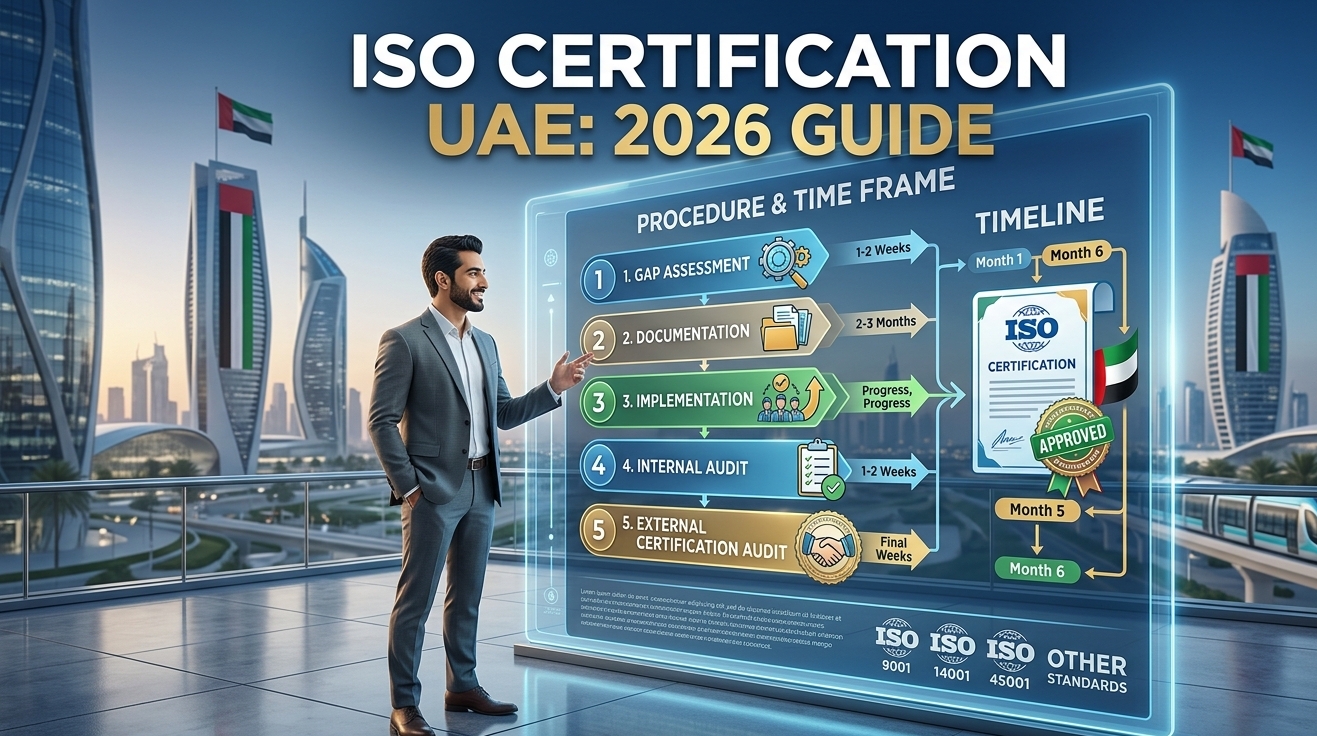
The entire process from initial gap assessment to certificate issuance usually takes between three and nine months, contingent on the size and complexity of the business and maturity of processes, and how quickly internal teams can take on necessary adjustments. Companies that are under severe time pressure are often tempted to shorten this timeframe significantly, but rush the implementation process will produce a management system that isn't able to perform at the initial audit, making a sensible timeline an investment that is truly worthwhile.
The increase in ISO certification in the UAE will show that the market has grown past treating safety and quality as a preference of the internal staff and now considers it a basic condition of doing business seriously, both locally as well as internationally. For any company that is ready to start, the most practical step is to have a brief, transparent conversation with an accredited certification body or a reputable consultant to determine which certification meets current needs and expectations, not just guessing according to what a competitor appears to have on their websites. Nothing in this current momentum suggests any signs of slowing making the current situation a sensible one to consider certifications to go from contemplation to decision. Follow the top rated ISO 9001 Certification for blog examples.
ISO 14001 Certification What Is Iso 14001? Environmental Management Matters For Uae Companies
Environmental considerations have moved beyond being a peripheral concern to an essential business concern across the UAE driven by country-wide sustainability pledges, and partly by rising client and regulatory expectations. ISO 14001, the international standard for environmental management systems, has become a natural response to companies that wish to demonstrate genuine and structured environmental responsibility and not just good will alone.What ISO 14001 Actually Requires
The standard asks businesses to analyze the environmental impact of their operations, understand what impact they have on their environment, and implement strategies that can manage and mitigate negative impacts in the course of time. This could mean anything that includes managing emissions and waste within a manufacturing facility to the reduction of energy consumption and paper use in an office-based service company, as the standard applies proportionately to any environmental impact a business's footprint appears to be.
Alignment with UAE's National Sustainability Goals
The UAE's commitments to the nation concerning sustainability and net-zero goals have created genuine institutional momentum in the field of environmental management. ISO 14001 certification gives individual businesses an opportunity to show their alignment with these broad goals. This aligning is becoming increasingly important for businesses that compete for government and semi-government contracts. In these cases, environmental certification is becoming an increasingly specific criteria for evaluating.
Industries - Where it's important
Manufacturing, construction oil and gas and logistics tend to face the greatest environmental scrutiny due to the sheer scale of their operations, but service-based businesses are increasingly striving for certification too, both in the interest of tender eligibility and for real cost savings through efficiency in resource usage. Even companies with light environmental footprint often find the structured approach reveals unexpected savings opportunities.
The Legal Compliance Angle
A significant aspect an important aspect of ISO 14001 involves identifying and checking compliance to relevant environmental legislation and rules and regulations. These requirements in the UAE scenario, spans federal environmental laws and regulations that are specific to emirates. Certified companies typically have a clearer, more recent understanding of their regulatory obligations than companies that are not certified. reducing the risk of accidental violations and the subsequent penalties.
Integration With Other Management Systems
Many UAE companies that want to pursue ISO 14001 already hold or are pursuing ISO 9001, and the two standards share sufficient structural similarities that an integrated management system covering both standards is often more efficient over treating them entirely distinct projects. This approach cuts down on duplicate documentation and audit efforts considerably for organizations that have multiple certifications.
What the Certification Process Looks Like
As with all management system standards Certification follows a predetermined route: an initial gap assessment, the implementing of required processes and documentation, internally audited, and following that, an external two-stage audit that is conducted by a certified certification body. Regular surveillance audits, usually annual, confirm the environmental management system is well-maintained rather than lapsing after the initial certification is issued.
Genuine Business Benefits Beyond the Certificate
Beyond tender eligibility and legal clarity, businesses that implement ISO 14001 properly often uncover significant savings in cost through more efficient resource and waste management, and also reputational benefits with more environmentally conscious clients and their partners. These practical benefits are part of why environmental certification has grown beyond being just a obligation-based process for a number of UAE companies.
How to Measure What Really Matters
A properly implemented ISO 14001 system focuses measurement efforts on elements of the environment that are important the most for a particular business, rather than tracking metrics purely because they're easy to track. A logistics company could prioritize fuel consumption and route efficiency and efficiency, while a manufacturing firm will be more concerned with waste generation and water use and reflect where the business's true environmental impact is.
The process of engaging suppliers and contractors
Many UAE enterprises have realized that a large portion of their overall environmental impact has to do with contractors and suppliers and not their own operations. ISO 14001 encourages businesses to be aware of this wider effect of supply chains, instead of considering environmental management as only an internal matter. This has prompted certain certified UAE companies to begin asking their suppliers directly about their environmental practices, resulting in an ensuing ripple effect in local supply chains.
Disaster Preparedness Is Part Of the Standard
ISO 14001 requires businesses to detect potential environmental emergencies that are relevant to their operations for instance, chemical spills equipment malfunctions that result in environmental impacts and implement effective preparedness plans for responding to such situations rather than dealing with such incidents reactively. This preparedness element often reveals gaps that businesses hadn't previously looked at, specifically in regards to staff preparedness for emergency situations.
A Standard That Rewards Genuine Engagement
In the end, ISO 14001 rewards businesses who treat environmental management as an ongoing priority instead of a documenting exercise carried out once and discarded. UAE companies that embed the standard's principles into daily management decisions, rather that separating it within an independent compliance function have the potential to reap substantial environmental and branding benefits in the course of time.
Water Management requires particular attention in the UAE Situation
With the arid climate of the UAE as well as its dependence on desalinated aquifers using and management of water, the UAE often require special attention within the ISO 14001 system compared with regions where water scarcity is less of a concern. Companies that incorporate water efficiency into their environmental management process right from the start tend to consider this to be among the most beneficial aspects of certification in the local context.
For UAE companies that are weighing ISO 14001, the certification can be seen as a way to respond to real regulatory and market pressure and an opportunity to control environmental impacts more efficiently, which concerns regulators, clients and the UAE's national sustainability goals. As the expectations for environmental sustainability across the UAE are increasing, businesses that build genuine environmental management capabilities today, instead of waiting for it to become a mandatory obligation, are likely to succeed in the coming years. This should not be overwhelming for smaller companies due to the fact that standard scales fairly, and even tiny environmentally-friendly improvements that are made regularly will satisfy auditors much more than a lofty plan that isn't followed through. Consistency, more than ambition alone, is ultimately what auditors as well as genuine environmental outcomes reward. Small, steady changes tend outperform ambitious strategies that slow down after the first few months. Follow the top rated ISO Consultants Dubai for site advice.